Chicago, IL real estate
Homes for sale, the monthly market report, selling, and the neighborhoods, all on one page for Chicago. Median value $425K, 47 days on market.
Chicago, IL holds about 1,277,054 homes, 46% of them owner-occupied, with a median year built of 1954. Housing stock ranges from multi-unit brick flats and vintage condominiums to detached city homes. Property buyers balance lot density and shared walls against suburban yard sizes in towns like Naperville or Downers Grove. Purchase decisions focus on street location and residential building age.
Chicago is read the same way as every other town here: comparable sales first, then the house.
Source: Redfin (through May 2026) · U.S. Census ACS (2024)
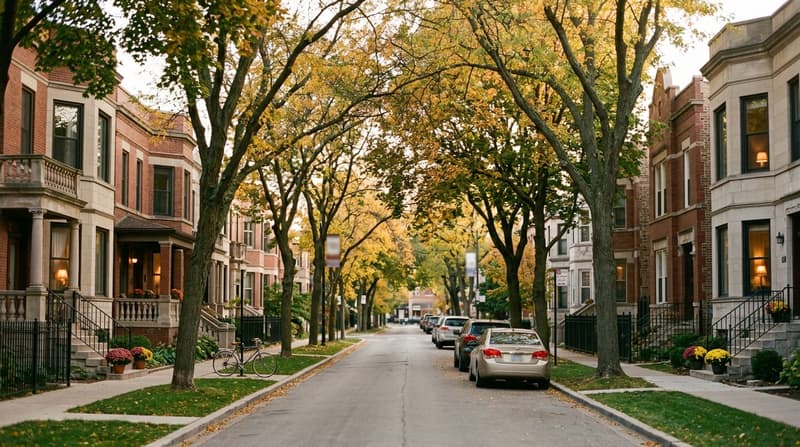

Chicago on record
- Population
- 2,711,226
- Households
- 1,160,205
- Median household income
- $77,902
- Median home value
- $334,100
- Median rent
- $1,440
- Owner-occupied
- 46%
- Median year built
- 1953
- Average commute
- 33 min
- County
- Cook County
- Land area
- 227.7 sq mi
Source: U.S. Census Bureau ACS 5-year, 2020–2024 5-year estimate; U.S. Census Bureau TIGER, Vintage 2024. Retrieved September 2026.
Neighborhoods in Chicago
The Loop
The central business district of Chicago is bounded by Lake Michigan, the Chicago River, and Roosevelt Road.
Lincoln Park
Located on the North Side along Lake Michigan, Lincoln Park is bounded by Diversey Parkway to the north, North Avenue to the south, and the Chicago River to the west.
Hyde Park
Situated on the South Side along Lake Michigan, Hyde Park extends from 51st Street to 60th Street, bounded westward by Washington Park.
Logan Square
Located on the Northwest Side, Logan Square is centered on Logan Boulevard, Kedzie Boulevard, and Milwaukee Avenue.
Pilsen
Pilsen sits on the Lower West Side, bounded by the BNSF railway tracks to the north, the South Branch of the Chicago River to the south and east, and Western Avenue to the west.
Lakeview
Bordered by Diversey Parkway, Irving Park Road, Ravenswood Avenue, and Lake Michigan, Lakeview features a mix of mid-rise brick courtyard buildings, high-rise lakefront towers, greystones, and converted walk-ups.
Also in Chicago: Albany Park, Andersonville, Andrews and Hurds Subdivision, Arcade Row, Archer Heights, Arizona, Armour Square, Ashburn, Auburn Gresham, Auburn Park, Austin, Avalon Highlands, Avalon Park, Avalon Trails, Avondale, Back of the Yards, Becks Park, Belmont Cragin, Belmont Gardens, Belmont Park, Beverly, Bowmanville, Brainerd, Bricktown, Brighton Park, Bronzeville, Brookdale, Bryn Mawr East, Bryn Mawr West, Essex, Forest Glen, Fulton Market District, Jackson Park Highlands District, Lakewood Balmoral Historic District, Marynook, O'Keeffe, Parkside, Peterson Park (39th Ward), The Island and Trumbull Park Homes. These have no page of their own yet; ask about any of them.
The Chicago market right now
The Chicago median sold price stands at $425,000 as of May 2026, +6% year over year. The twelve-month peak was $425,000 in April 2026. 24,715 homes closed over the period, averaging 101.8% of list price most recently, with 47 days on market.
Chicago neighborhoods side by side
| Neighborhood | Housing stock |
|---|---|
| The Loop | Residential stock consists exclusively of multi-unit high-rises and mid-rises, including converted historic commercial masonry towers and modern glass condominium buildings. Structures feature integrated parking garages set directly onto a dense commercial grid. |
| Lincoln Park | Late 19th-century brick and greystone row houses, detached Victorians, and three-flats share a standard grid with mid-rise and high-rise condominiums along the park edge. Lots commonly measure 25 by 125 feet, and detached rear garages accessed by alleys are standard. |
| Hyde Park | Housing includes late 19th- and early 20th-century brick two-flats, greystones, mid-century high-rise towers, and detached Prairie and Queen Anne houses. Streets follow a rectangular grid with rear alleys, and detached garages or surface spaces provide parking. |
| Logan Square | The area features late 19th- and early 20th-century brick and greystone multi-flats, single-family bungalows, and Queen Anne houses on standard 25-foot lots. Properties border wide landscaped boulevards and grid streets with detached garages along rear alleys. |
| Pilsen | Built largely between the 1870s and 1920s, the stock consists of two- and three-flat brick walk-ups, frame workers cottages, and masonry industrial lofts. Standard 25-by-125-foot lots align along a dense street grid served by service alleys with rear garages. |
| Lakeview | Housing consists of Victorian frame residences, masonry greystones, brick courtyard buildings, and lakefront high-rise condominium towers. Most properties sit on standard 25-foot urban grid lots with alley-fed detached garages alongside newer multi-unit infill. |
School districts in Chicago
From public records, with the source for each. District boundaries do not follow city lines; check the address with the district.
Chicago Public School District 299
Grades PK–12 · Unified district · NCES EDGE school district boundaries 2024-2025, September 2026
Alsip-Hazelgreen-Oaklawn School District 126
Grades PK–8 · Elementary district · NCES EDGE school district boundaries 2024-2025, September 2026
Argo Community High School District 217
Grades 9–12 · High school district · NCES EDGE school district boundaries 2024-2025, September 2026
Atwood Heights School District 125
Grades PK–8 · Elementary district · NCES EDGE school district boundaries 2024-2025, September 2026
Bensenville School District 2
Grades PK–8 · Elementary district · NCES EDGE school district boundaries 2024-2025, September 2026
Burbank School District 111
Grades PK–8 · Elementary district · NCES EDGE school district boundaries 2024-2025, September 2026
Burnham School District 154-5
Grades KG–8 · Elementary district · NCES EDGE school district boundaries 2024-2025, September 2026
Calumet Public School District 132
Grades PK–8 · Elementary district · NCES EDGE school district boundaries 2024-2025, September 2026
Districts are listed by name and source only, never by rating: choosing a home by school quality is yours to weigh, and fair-housing law keeps an agent out of steering it.
Living in Chicago
About Chicago
Chicago is an incorporated city of 2,711,226 residents located in Cook County. The municipality contains 48 recognized neighborhoods, each offering residential opportunities at varying distances from central anchors. Prominent landmarks within the city include Willis Tower and Navy Pier.
Travel times across the area depend on your destination and route. Driving to The Loop takes 2 minutes across a distance of 0.3 miles. A trip to Midway International Airport requires a 26-minute drive over 11.2 miles. Reaching Oak Brook requires a 45-minute drive covering 20 miles. These travel times suit you if your routine demands direct access to core commercial centers, suburban job hubs, and regional airports.
The market section below outlines current inventory levels, local pricing trends, and recent property sales across the city.
Is Chicago a good place to live?
Chicago spans 227.7 sq mi across Cook County, providing substantial room for widespread residential communities. The city records an overall population of 2,711,226 across 1,160,205 separate residential households. Economic data indicates a median household income of $77,902 throughout the municipality. Understanding these baseline figures helps you evaluate the overall scale and economic setting of the area.
Housing data illustrates the split between local homeownership and the rental market. The owner-occupied share across the city is 46.0 percent, pointing to a balanced mix of owners and renters. Prospective home buyers encounter a median home value of $334,100 across the local housing stock. Renters navigating the residential market encounter a median rent of $1,440 each month. Residential buildings have an established history, with a median year built of 1953 across the city. Getting to work involves an average commute of 33 minutes for local travelers. Together, these statistics provide you with concrete benchmarks for housing costs, property age, and travel times.
Chicago at a glance
Covering 227.7 square miles in Cook County, Chicago has 1,160,205 households and an overall population of 2,711,226. You can review the table below for baseline metrics, including the median home value of $334,100, median rent of $1,440, and a commute of 33 minutes.
Homes and neighborhoods in Chicago
Homes built before 1940 account for 38.8 percent of residential stock across Chicago. In The Loop, residential options consist exclusively of multi-unit high-rise and mid-rise buildings. The housing includes converted historic commercial masonry towers as well as modern glass condominium buildings. These structures feature integrated parking garages that sit directly on a dense commercial street grid.
Lincoln Park and Lakeview combine street-level housing with high-rise condominium buildings along the park edge and lakefront. In Lincoln Park, late 19th-century brick and greystone row houses, detached Victorians, and three-flats share a standard grid. Lots in Lincoln Park commonly measure 25 by 125 feet, and detached rear garages accessed by alleys are standard. Lakeview features Victorian frame residences, masonry greystones, brick courtyard buildings, and newer multi-unit infill on standard 25-foot urban grid lots.
Logan Square features late 19th- and early 20th-century brick and greystone multi-flats, single-family bungalows, and Queen Anne houses on standard 25-foot lots. Properties there border wide landscaped boulevards and grid streets with detached garages along rear alleys. Pilsen consists of two- and three-flat brick walk-ups, frame workers cottages, and masonry industrial lofts built largely between the 1870s and 1920s. In Hyde Park, you see late 19th- and early 20th-century brick two-flats, greystones, mid-century high-rises, and detached Prairie and Queen Anne houses. Rectangular grid streets with rear alleys provide detached garages or surface spaces in Hyde Park.
The Chicago housing market
The Chicago housing market shows steady activity across the 12-month period ending in August 2026. The median sold price reached $483,000 in August 2026, up from $469,000 in September 2025. Homes also sold slightly faster at the end of this stretch. The average days on market dropped from 20 days in September 2025 to 17 days in August 2026.
Inventory and completed purchases remained consistent throughout the year. Buyers closed on 13 homes in August 2026, compared to 12 closed sales in September 2025. Sellers introduced 20 new listings to the market in August 2026, following 21 new listings in September 2025. The sale-to-list price ratio shifted from 99.0 percent down to 97.9 percent during this timeframe. You can review the full market report to track month-to-month changes across the city.
Housing stock
Multi-unit buildings dominate the local housing supply and account for 70.5% of all residential properties in Chicago. Single-family detached homes make up 25.6% of the mix, while single-family attached residences represent 3.5%. Manufactured housing and other dwelling types total 0.3% of the inventory.
You will encounter a substantial volume of established architecture across the city. Residential structures built before 1940 comprise 38.8% of the total housing stock. Homes built between 1940 and 1969 represent 28.7%, and properties dating from 1970 through 1999 account for 17.6%. Construction from 2000 to 2009 represents 8.6%, while properties constructed in 2010 or later make up 6.3%.
Schools serving Chicago
Multiple school districts serve areas across Chicago. Chicago Public School District 299 operates as a unified district serving prekindergarten through twelfth grade. High school students in certain boundaries attend Argo Community High School District 217, which covers grades 9 through 12.
Elementary districts serving prekindergarten through eighth grade include Alsip-Hazelgreen-Oaklawn School District 126, Atwood Heights School District 125, and Bensenville School District 2. Other elementary providers include Burbank School District 111, Calumet Public School District 132, and Burnham School District 154-5, which serves kindergarten through eighth grade. For higher education options in the city, you will find The University of Chicago.
Getting around
Public transportation options include Chicago Union Station. If you commute to The Loop, driving covers 0.3 miles and takes two minutes. That same trip to The Loop takes 13 minutes over one mile when you ride transit.
Reaching Midway International Airport takes 26 minutes by car across 11.2 miles, or 67 minutes across 11.3 miles by transit. If you travel to Oak Brook, the drive takes 45 minutes to cover 20 miles. Taking transit to Oak Brook covers 21.2 miles and requires 117 minutes.
Things to do in Chicago
You can explore open grounds and recreation corridors across the city throughout the year. Millennium Park provides public green space and connections to nearby outdoor destinations. If you prefer walking or cycling, The 606 offers a designated trail route through urban neighborhoods. You can also walk along the pedestrian paths of the Chicago Riverwalk, or you can spend an afternoon at North Avenue Beach along the lake.
Spectator entertainment and athletic competitions center around prominent venues in the city. You can attend games and major events at Wrigley Field, or you can see matches and live performances at the United Center. If you want to play a round of golf, you can choose between Sydney R. Marovitz Golf Course and Jackson Park Golf Course. Both courses give you outdoor athletic options within city limits.
Civic institutions provide indoor study areas, expansive collections, and quiet working environments across the community. You can visit the Harold Washington Library Center, which serves as the central anchor for the Chicago Public Library. This facility offers public reading rooms, reference materials, and spaces to read or study downtown. Additional branch locations of the library system serve readers throughout different parts of Chicago.
Working in Chicago
You will find several large organizations anchoring employment across Chicago. Northwestern Memorial Hospital operates as a health system and serves as a major employer. Rush University Medical Center also functions as a health system and a major employer. United Airlines Headquarters maintains its corporate headquarters in Chicago within the aviation sector. You can explore career opportunities across these health systems, corporate facilities, and aviation offices.
Pros and cons of living in Chicago
Living in Chicago offers quick access to central employment hubs and established housing options. A drive to The Loop covers 0.3 miles in 2 minutes. Midway International Airport sits 11.2 miles away, which takes 26 minutes by car. The overall median home value is $334,100, and the median monthly rent is $1,440.
Other factors require planning when you evaluate travel times and housing conditions. The average commute across the city is 33 minutes, while driving 20 miles to Oak Brook takes 45 minutes. Most residential structures are older, reflecting a citywide median construction year of 1953. In August 2026, the market recorded 20 new listings, 13 closed sales, and an average of 17 days on the market. The median sold price reached $483,000 that month, with buyers paying 97.9% of list price. Owner-occupied units account for 46.0% of homes across the 227.7 square miles of land in Cook County.
Sources: U.S. Census Bureau ACS 5-year; U.S. Census Bureau TIGER.
Tell me what you're trying to do
Buying, selling, or still deciding, a short note is enough to start. You'll get a real reply from me, not an auto-responder.
- A person reads every message
- No drip campaign, no lead-sharing with other agents
- Happy to answer one question and leave it there
Talk to someone who works Chicago
I have 2 years in these neighborhoods and answer personally.